
The best sidechain pump plugin for most producers is whichever one exposes the gain movement clearly instead of making you guess at a compressor's attack and release. RysUpPump is our value pick at $9.99. Nicky Romero Kickstart 2 is the preset-first option at $16. Cableguys ShaperBox 3 is the deep multi-effect choice at 99 EUR. Xfer Records LFOTool is the custom LFO and modulation option at $49.95. Devious Machines Duck 2 is the dedicated multiband ducking option at $29.99.
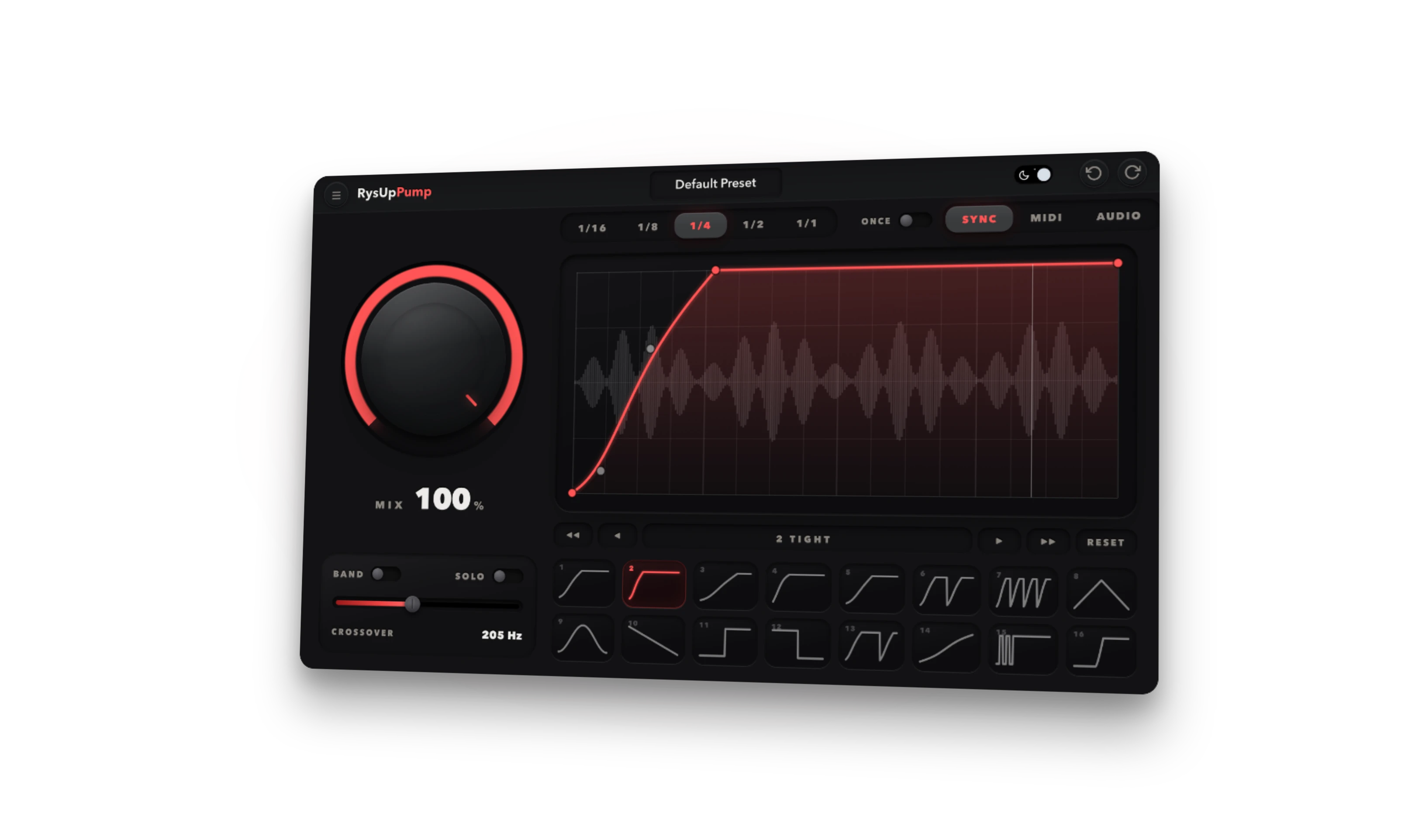
The blunt answer: a compressor was never designed to make a kick breathe. You set a threshold, a ratio, an attack, and a release, then you hope the curve in between lands where you wanted it. A volume shaper skips the guessing. RysUpPump gives you sixteen editable curves, five sync rates from a sixteenth note to a full bar, and a crossover so only the low end ducks.
That does not make the other options pointless. Kickstart 2 supplies sixteen curves, drag-to-fit timing, audio triggering, and lows-only multiband sidechaining. ShaperBox 3 bundles eleven different shapers, so the same drawn curve can drive filtering, panning, time, and pitch, not just volume. LFOTool provides custom point-and-tension LFO curves, multiple simultaneous graphs, and MIDI CC output. Duck 2 goes multiband and leans hard into the ducking use case specifically.
Disclosure: Rys Up Audio makes RysUpPump. We rechecked competitor prices and features against official product pages on August 23, 2026. We did not run a blind listening test across all five, so this guide does not invent a sound quality winner. Kickstart 2 publishes 14 EUR / $16 on its own product site. ShaperBox shows 99 EUR and compares it with 379 EUR for the individual products combined. The Devious Machines figure was a summer sale price down from $39.99.
The five picks in 30 seconds
Best value: RysUpPump
$9.99. Sixteen editable curves with hard, medium, and soft corner control per point. Sync, MIDI, and audio triggering. Optional crossover so only the low band ducks, with solo monitoring.
Best preset-first workflow: Nicky Romero Kickstart 2
$16. Sixteen supplied curves, drag-to-fit timing, audio triggering, and lows-only multiband sidechaining in a deliberately fast workflow.
Best full toolkit: Cableguys ShaperBox 3
99 EUR. Eleven shapers sharing one curve editor, so the same drawn envelope can move volume, filter, pan, time, pitch, drive, and more. The category reference.
Best modulation workhorse: Xfer LFOTool
$49.95. Custom point-and-tension LFO curves, multiple simultaneous graphs, sample-accurate sync, and MIDI CC output for driving other instruments and hardware.
Best dedicated ducker: Devious Machines Duck 2
$29.99. Multiband ducking with graphical envelopes, triggered from MIDI, a sidechain input, or the audio itself. Built around the ducking job specifically.
Why a drawn curve beats a compressor for pumping
Sidechain compression became the default way to duck a bass under a kick because it was the only tool most people had. It works, but it hides the thing you actually care about. The gain movement is a side effect of four interacting controls, and it changes whenever the source level changes.
A volume shaper inverts that relationship. You draw the gain movement, and it happens the same way every bar regardless of how loud the kick is. That matters in three specific situations:
- Consistency across a whole arrangement. The duck stays identical whether the kick is layered, filtered, or briefly muted.
- Shapes a compressor cannot make. A hold at the bottom, a two stage release, an offbeat gate, or a curve that recovers faster than it falls.
- Sound design that is not ducking at all. Tremolo, gating, stutter, and rhythmic chops are the same drawn curve at a different rate.
How they compare on the things that matter
| Plugin | Price | Editable curve | Band split | Triggering | Copy protection |
|---|---|---|---|---|---|
| RysUpPump | $9.99 | 16 slots, per point corner control | Crossover with solo | Sync, MIDI, audio | License key |
| Nicky Romero Kickstart 2 | $16 | 16 supplied curves with drag-to-fit timing | Multiband lows-only mode | Beat, MIDI, audio | License key |
| Cableguys ShaperBox 3 | 99 EUR | Yes, across 11 shapers | Three bands | Beat, MIDI, audio | License key |
| Xfer Records LFOTool | $49.95 | Yes, multiple graphs | No | Beat, MIDI | License key |
| Devious Machines Duck 2 | $29.99 | Yes, graphical envelopes | Multiband | MIDI, sidechain, audio | License key |
Prices checked on official product pages August 23, 2026. Kickstart 2 publishes 14 EUR / $16 on its own site. ShaperBox's 379 EUR comparison is the combined individual-product value, not a verified regular standalone price. Sales, currencies, and bundle contents change often. Check the vendor before buying.
Which one should you actually buy
A volume shaper is a creative part of a bigger production chain. If the vocal itself still needs cleanup or tone work, browse the vocal mixing plugin collection before adding more pumping.
Buy RysUpPump if you mostly want the pump itself and you want it to cost almost nothing. Sixteen curves cover the shapes people actually reach for, the crossover handles the common case where only the sub should move, and it is included in the Rys Up Suite if you want the rest of the catalog too.
Buy Kickstart 2 if you want a fast preset-first workflow with drag-to-fit timing, audio triggering, and lows-only multiband sidechaining. RysUpPump undercuts it and offers per-point editing plus per-slot resets, but Kickstart is a completely reasonable buy.
Buy ShaperBox 3 if you want one curve editor driving many kinds of modulation, not just volume. If you already know you want to shape filter and time with the same envelope, the bundle is the point.
Buy LFOTool if you want multiple custom LFO graphs or need MIDI CC output to modulate external gear.
Buy Duck 2 if ducking specifically is your whole use case and you want multiband control over how each part of the spectrum reacts.
Common mistakes when you start using a volume shaper
- Ducking the full range when only the sub needed it. This is why the crossover exists. Pulling the whole bass part down takes the vocal and hats with it and makes the mix feel like it is breathing in and out.
- Leaving mix at 100 percent by reflex. Blending the shaped signal back against the dry one gives you a gentler duck without redrawing anything.
- Fighting the grid. If the pump feels late, the rate is usually wrong, not the curve. Try the next rate up before you start dragging points.
- Using a looping curve for a one time drop. One shot mode plays the shape once per trigger, which is what a single dramatic duck needs.
Frequently asked questions
Is a volume shaper the same as sidechain compression?
No. Sidechain compression reacts to an input signal and produces gain movement as a result. A volume shaper applies a gain curve you drew, in time with the host. The audible result can be similar, but the shaper is repeatable and does not change when the trigger level changes.
Do I need to route a sidechain input?
Not with RysUpPump in sync mode. The curve follows host tempo and playhead position, so nothing has to be routed. MIDI and audio triggering are there if you prefer to drive it from an actual kick.
Will it work in my DAW?
RysUpPump ships as AU, VST3, and AAX for macOS Universal and Windows 64 bit, which covers Logic Pro, Pro Tools, Ableton Live, FL Studio, Studio One, Cubase, Reaper, GarageBand, and Bitwig Studio.
Reaper producers can route the pump effect after an editable Reaper vocal starting chain, keeping intelligibility work separate from rhythmic movement.
For the complete vocal workflow around that movement, compare Pro Tools vocal preset chains built for the Avid session.
Does it add latency?
Gain shaping itself is a sample by sample multiply, so it does not require lookahead. Turning on the crossover introduces the latency of the band split filter, which the plugin reports to the host so delay compensation handles it.
For rhythmic changes in tone rather than volume ducking or audio slicing, read our filter plugin guide. Related comparisons cover FilterFreak alternatives, FilterShaper XL alternatives, and Volcano 3 alternatives.
Building into the drop? RysUpSweep turns any track into the build on one knob, with Club Safe mono bass. Compare options in our riser plugin roundup.