
TL;DR — Which One Should You Use?
For most producers: RysUpComp. Same FET-style compression character, modern codebase, no license drama, fraction of the cost.
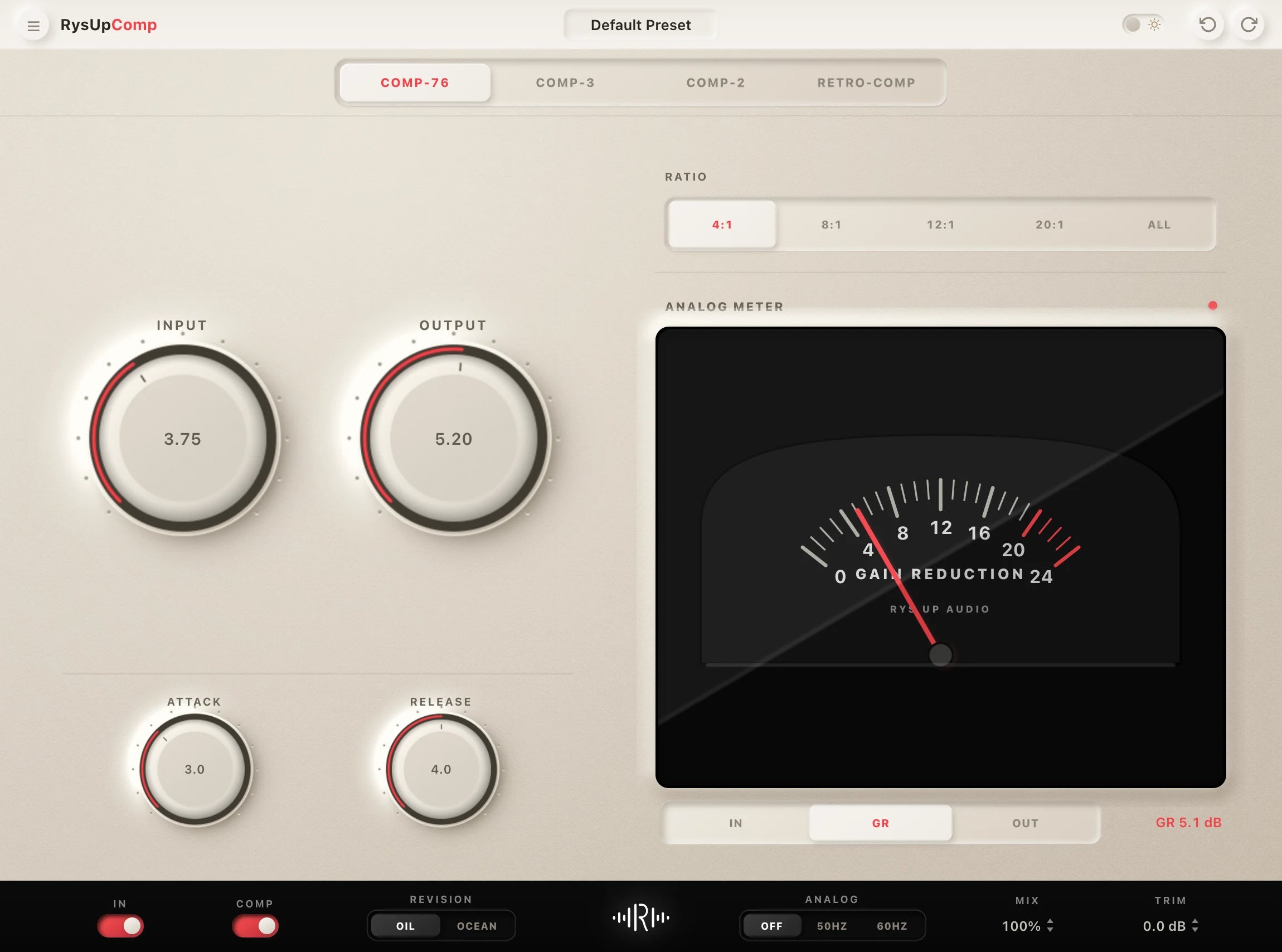

For studio veterans with Waves already installed: If the CLA-76 is already in your chain and working, keep it. It sounds good. But if you're starting fresh in 2026, there's no compelling reason to bring Waves into your setup when a modern alternative exists that costs less and causes fewer headaches.
Full breakdown below.
What Is the Waves CLA-76?
The Waves CLA-76 is a digital emulation of the Urei 1176LN — one of the most famous FET (field-effect transistor) compressors ever made. The original 1176 hardware has been on more hit records than almost anything else in history. The Beatles. Led Zeppelin. Michael Jackson. Kendrick Lamar. It's a genuinely legendary circuit.
The Waves version, tuned by mix engineer Chris Lord-Alge (hence "CLA"), became a DAW staple in the 2000s and 2010s. Fast attack and release, punchy character, a famous "all buttons in" mode that overdrives all four ratio buttons simultaneously for a heavily saturated sound. At the time, it was one of the first high-quality 1176 emulations that home producers could actually afford, and it delivered.
The question is whether it still makes sense to choose it in 2026.
What Is RysUpComp?
RysUpComp is a modern FET-style compressor built from scratch in 2025. It takes the core 1176 design philosophy — fast transient response, ratio-driven limiting, punchy forward character — and rebuilds it with a clean modern codebase that runs without the overhead of legacy software.
It's available through the RysUp plugin installer and runs on Mac and PC without any license server, activation limits, or subscription requirement. No Waves Central, no dongles, no version upgrade fees.

Sound Character Comparison
Waves CLA-76
The CLA-76 sounds punchy, forward, and slightly colored. The FET character adds a subtle bite to transients — brightness and edge that makes vocals cut through mixes. The "Bluey" mode (based on Rev E) is warmer and more musical for most vocal applications; the "Blacky" mode (Rev A) is more aggressive with faster limiting.
The all-buttons-in mode is genuinely distinctive. You get a saturated, pushing sound that nothing else replicates exactly in the same way. If you've built an entire workflow around this specific behavior, it's legitimately hard to replace one-to-one.
The downside: the Waves emulation was built on older modeling technology. Compared to newer designs, it can sound slightly stiff on extreme settings — aggressive pumping that doesn't feel as organic as the hardware it's emulating.
RysUpComp
RysUpComp delivers the same FET energy — fast attack and release, punchy character, ratio-driven limiting — using modern signal processing. The result is a compressor that responds naturally across a wide range of settings without the artifacts that legacy emulations sometimes introduce.
On vocals, the character is punchy and present without excessive coloration. The compression curves feel musical rather than mechanical, and the drive control adds harmonic complexity that leans warm rather than harsh.
Is it identical to hardware? No — and neither is the Waves CLA-76. Both are interpretations. RysUpComp's interpretation is built on a modern foundation.
Feature-by-Feature Comparison
| Feature | Waves CLA-76 | RysUpComp |
|---|---|---|
| Compression type | FET emulation (1176 model) | FET-style, modern build |
| Attack range | 0.1ms – 10ms | 0.1ms – 100ms |
| Release range | 50ms – 1100ms | 10ms – 1000ms |
| Ratio options | 4:1, 8:1, 12:1, 20:1, All-In | 1:1 – 20:1 (continuous) |
| Parallel mix control | Via DAW routing only | Built-in dry/wet knob |
| Sidechain filter | Highpass sidechain | Full sidechain EQ |
| Oversampling | Limited | Up to 4x |
| License server required | Yes (Waves Central) | No |
| macOS Sequoia/latest Windows | Waves V14+ required (extra cost) | Full support, always current |
| Update model | Paid major version upgrades | Free updates |
| Price | $29.99–$99.99 | Free / fraction of cost |
UI and Workflow
Waves CLA-76
The CLA-76 interface is a faithful recreation of the hardware front panel — horizontal faders for Input, Output, Attack, and Release; discrete buttons for ratio selection. It looks exactly like the real thing, which is great if you learned compression on hardware.
The downside: the UI was designed to replicate a physical device, not to be intuitive on a modern screen. Faders are small, the VU meter isn't easy to read at normal zoom levels, and there's no visual feedback on what the compressor is doing to your dynamics. If you don't already know how an 1176 works, this interface doesn't teach you anything.
Then there's Waves Central. Every Waves plugin requires managing your license through their separate software. This has caused problems for producers for years — licenses breaking after OS updates, needing to re-download everything when switching computers, plugins becoming unusable when offline. For a home studio tool, it's unnecessary overhead.
RysUpComp
RysUpComp takes a cleaner approach: clearly labeled controls, visual feedback showing what the compressor is doing to your signal, and a layout that makes sense on a modern screen. The GR meter is large and readable. Attack, release, and ratio controls are intuitive whether you've been mixing for ten years or ten days.
No license software. Open your DAW, load the plugin, it works. That's the whole experience.
The Waves License Problem — Worth Understanding
This deserves its own section because it's become a real issue in the producer community over the last few years.
Waves plugins require Waves Central — their license management and update software. Over time, this system has:
- Broken compatibility with new macOS and Windows versions until a paid "version upgrade" is released (V12 → V13 → V14)
- Caused producers to lose access to plugins they paid for after changing computers
- Required re-installation from scratch after clean OS installs
- Conflicted with other audio software on some systems
In 2022, Waves announced a subscription model before walking most of it back after intense backlash. A significant portion of the producer community moved to alternatives and didn't look back. That shift was mostly permanent.
RysUpComp has none of this. Download, use, update when updates are available. Nothing to manage separately, no risk of losing access.
Pricing Over Time
| Waves CLA-76 | RysUpComp | |
|---|---|---|
| Initial purchase | $99.99 (full) / $19.99–$29.99 (sale) | Free / Low cost |
| Major version upgrade (1-2 yrs) | $29–$99 per upgrade | Free forever |
| Estimated 5-year total cost | $80–$300+ | Free / one-time low cost |
| Subscription option | Yes (Waves Creative Access) | No subscription needed |
Even at $29.99 on sale, the CLA-76 becomes more expensive once you factor in version upgrade cycles. Every major OS release is a potential licensing event that requires a paid update to resolve.
Who Should Use the CLA-76
The Waves CLA-76 makes sense if:
- You already own it and it's working in your current setup — don't change what works
- You specifically need the "all buttons in" mode sound for a distinctive character you've built a workflow around
- You're working in a commercial studio where the Waves license is managed by someone else
- You're on an older OS and version compatibility isn't a current concern
If none of those apply, choosing the CLA-76 in 2026 means buying into a platform with known friction for an advantage that mostly existed in a context that no longer applies.
Who Should Use RysUpComp
RysUpComp makes sense if:
- You're building a vocal chain from scratch in 2026
- You want professional FET-style compression without license management overhead
- You're on Apple Silicon or a recent Windows build and want guaranteed compatibility
- You want a compressor that won't break on an OS update
- You want to spend less money without sacrificing professional results
- You want the built-in parallel mix control instead of routing through your DAW
Using RysUpComp for Vocals — Settings Guide
Here's how to dial in RysUpComp for the most common vocal scenarios:
Punchy Lead Vocal (Hip-Hop, Pop)
- Ratio: 4:1
- Attack: 2-5ms
- Release: 50-80ms
- GR target: 4-6dB on average phrases
- Character: Adds definition and presence, tightens transients
Smooth R&B Vocal (Gentle, Warm)
- Ratio: 2:1 – 3:1
- Attack: 15-25ms (let the note's breath and attack come through)
- Release: 100-150ms
- GR target: 3-5dB
- Character: Maintains dynamic range while controlling peaks, preserves intimacy
Parallel Compression (NY-Style, for Density)
- Ratio: 10:1 – 20:1
- Attack: 0.3-0.5ms (very fast — intentionally squash transients)
- Release: 40-60ms
- GR target: 10-15dB (heavy compression)
- Mix: 20-30% (blend with dry signal — punch without losing dynamics)
The built-in dry/wet mix knob in RysUpComp makes parallel compression significantly easier than doing it through DAW routing. This is a direct practical improvement over the CLA-76 approach for this technique.
Drum Bus and Instrument Compression
- Ratio: 4:1 – 8:1
- Attack: 5-10ms
- Release: 100-200ms (tune by ear — faster release gives more pump)
- GR target: 3-6dB
- Character: Glue and punch — especially effective on parallel drum bus
When to Use Each Plugin Together
If you already have both, they're not mutually exclusive. A common approach in professional mixing is stacking two compressors in series — each doing less work, together achieving more natural-sounding control:
- RysUpComp first: Handle 3-4dB of fast transient control
- Parallel RysUpComp second: Add density via parallel mix
Or, if you have the CLA-76 for a specific character insert and want a cleaner second stage:
- CLA-76 first: For the colored FET character and specific attack feel
- RysUpComp second: For transparent level control and gain staging
Neither plugin is the "only" answer — they're tools.
Bottom Line
The Waves CLA-76 is a legitimate plugin with a long track record. It sounds good. The modeling is based on genuinely iconic hardware. If you already own it and it's working, there's no compelling reason to stop using it.
But if you're building a new studio setup or evaluating compressors from scratch in 2026, RysUpComp delivers comparable FET-style compression with a modern build, better OS compatibility, no license complexity, a built-in parallel mix control, and at a fraction of the cost. For producers starting fresh, that's a strong case.
Ready to try it? Download RysUpComp free through the RysUp plugin installer and test it on your next vocal session. Side by side against the CLA-76 if you have it. Trust your ears.
Compare compression behavior inside editable R and B vocal preset chains, then level match the result before choosing the faster or smoother direction.
Pair Your Vocals With RysUp Plugins
If you want to upgrade your vocal chain, every plugin in the RysUp collection is built specifically for vocal production — modern codebase, weekly updates, no iLok, and a fraction of the cost of legacy software.
Fast compression only works when the timing fits the vocal. Follow this complete vocal compression workflow to set the detector and recover articulation before choosing a model.